Home › What Is a Destination Fee?
What Is a Destination Fee at a Hotel?
A destination fee is a mandatory nightly surcharge added to your hotel bill, separate from the room rate. It is the same charge under a different name.
What Guests Actually Pay
Same city, same destination fee, $25 or $35, just depends on the hotel.
| Hotel / City | Destination fee reported | Source |
|---|---|---|
| Union Square hotel, San Francisco | $38 per day | r/marriott, 2026-10-20, "I hate destination fees…", t3_1xb6pmg |
| Several hotels, New Orleans | $25 to $35 per day | r/marriott, 2026-07-19, "Daily Destination Fee charges starting to appear", t3_1v0wbd7 |
| Hotels, New York City | $40 per night plus tax | r/visitingnyc, 2025-10-26, "Hotel room tax and destination fee", t3_1ogwis3 |
| BoweryNyc, New York City | $30 per day | r/hyatt, 2025-11-04, "Destination Fee", t3_1ooclii |
Amounts in this table are guest-reported, not hotel-listed rates.
Same Charge, Different Names
| What hotels call it | What it actually is |
|---|---|
| Destination fee | Mandatory nightly surcharge, rebranded for city hotels |
| Resort fee | Same charge, used at resort properties |
| Amenity fee | Same charge, emphasizing included perks |
| Urban fee | Same charge, used in dense metro markets like New York and Chicago |
| Facility fee | Same charge, framing it as building access |
The name changes by location and marketing, but the charge stays the same.
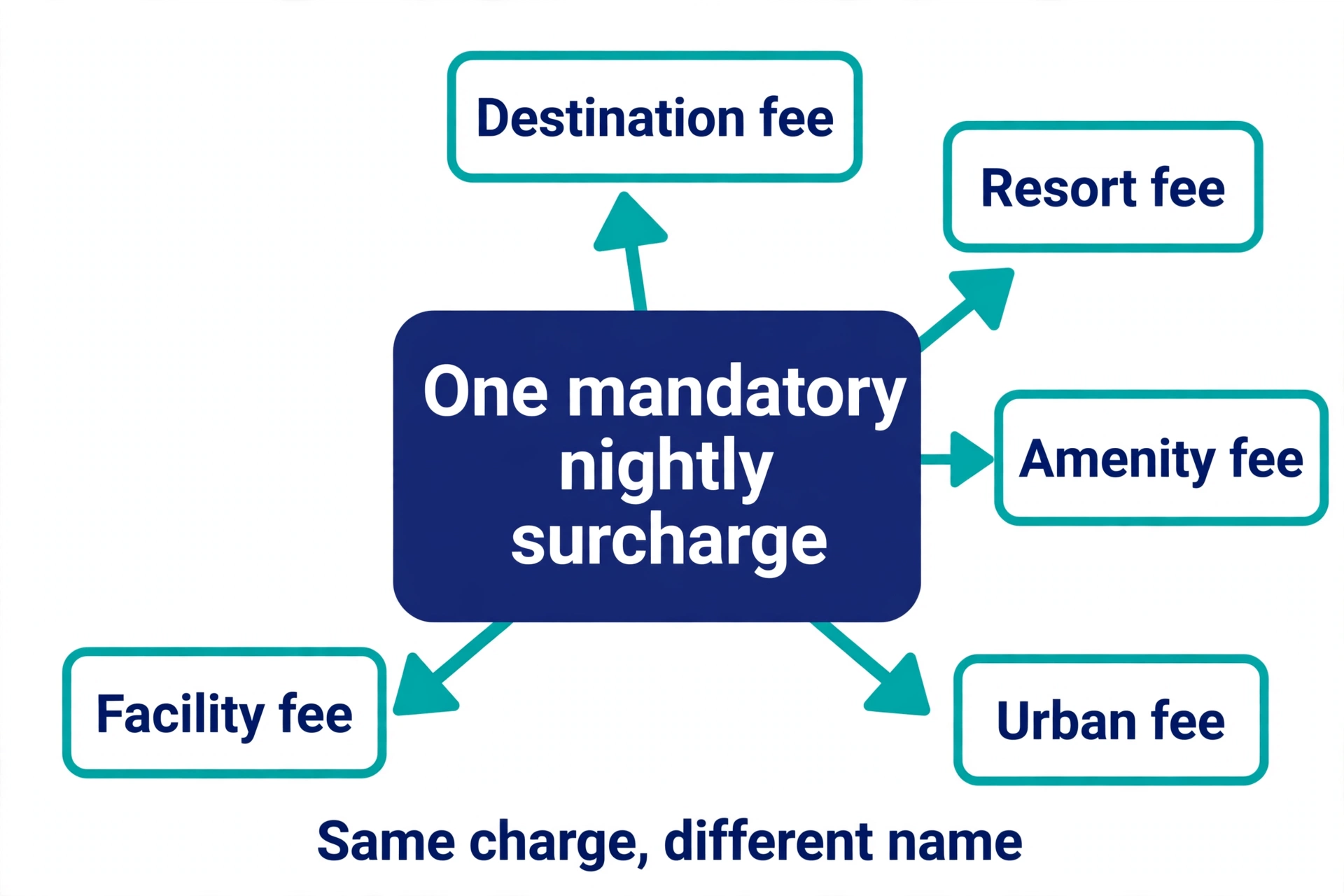
Resort charge is one more name for the same fee. Our Las Vegas resort fees page has a section explaining it.
The question is answered in full on our what is a resort fee page.
The FTC Rule Effective May 12, 2025
May 12, 2025. The FTC's Rule on Unfair or Deceptive Fees, 16 C.F.R. Part 464, took effect that day. Hotels must now show the total price upfront. All mandatory fees included. No more hiding the destination fee until checkout.
The rule does not ban destination fees or cap their amount. It only requires hotels to show the total price upfront.
The FTC rule covers third-party booking platforms too, not just hotels selling directly.
The FTC's own example is a $199 room plus a $39 resort fee, and the $39 must be in the advertised total price. That puts the advertised total at $238, self-calculated as $199 + $39.
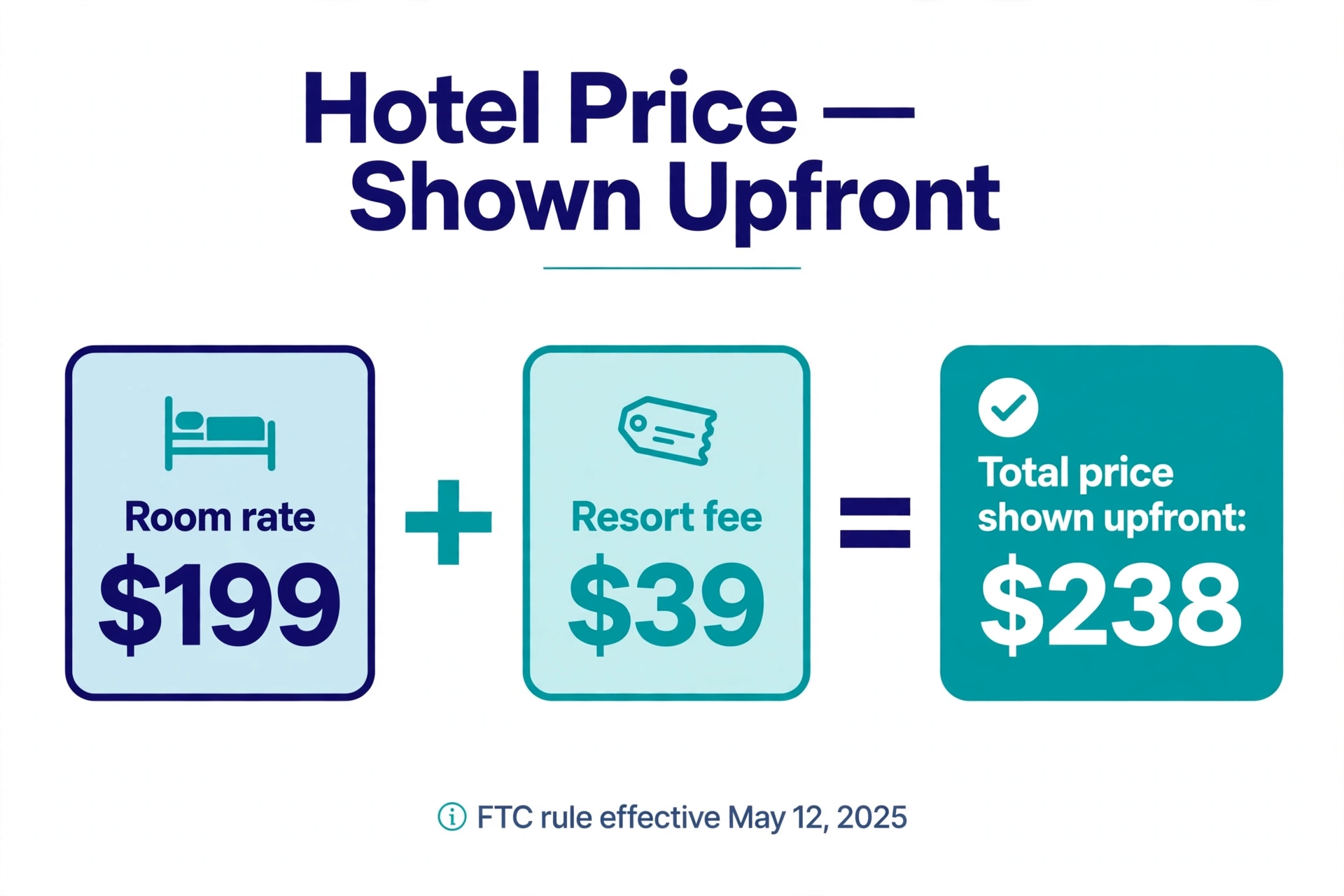
Same pattern across three cities. San Francisco, New Orleans, New York. The fee appears at checkout. Not in the advertised rate.
A commenter on r/marriott (2026-07-19, t3_1v0wbd7) wrote: "Destination fees aren't new but they are becoming more common. If enhanced Wi-Fi is included in the destination fee the hotel is supposed to provide a replacement benefit for Gold and above." The comment received 25 upvotes.
Marriott Gold members should ask for their replacement benefit when Wi-Fi is bundled into the destination fee, because the hotel is supposed to provide one.
Another commenter on the same thread wrote: "show price with all taxes and fees." The comment received 17 upvotes. The FTC rule is supposed to make that the default, not the exception.
May 2026, Lisbon. I stayed at a hotel, and at checkout there was an 8 euro municipal tourist tax for two people. Different name, same charge.
Las Vegas Hotels Charge It Too
Las Vegas hotels charge this same fee under the name resort fee. Three examples from our verified table:
| Hotel | Resort fee per night | With 13.38% tax |
|---|---|---|
| Bellagio | $55.00 | $62.36 |
| MGM Grand | $50.00 | $56.69 |
| Four Queens | $0 | $0 |
Bellagio $55. Four Queens zero. Same city.
The full 42-hotel table is on our Las Vegas resort fees page.
Questions
Is a destination fee the same as a resort fee?
Yes. Same mandatory nightly surcharge, different name. City hotels use destination fee because they cannot call themselves resorts.
Do I have to pay it if I do not use the amenities?
Yes. The fee applies whether or not you use the gym, Wi-Fi, or pool. It is not optional.
Does the FTC rule mean the fee is gone?
No. The rule requires hotels to show the total price upfront. The fee still exists, but it can no longer be hidden until checkout.